By admin on 05 Aug 2026
Money in Egypt confuses first-time visitors because the exchange rate keeps moving. In March 2026, the US dollar bought around 52 Egyptian pounds—twice what it bought in 2022. That means Egypt is one of the best-value destinations in the world right now, but it also means the tipping culture, the cash-versus-card decisions, and the withdrawal strategy all work differently than they did a few years ago.
This guide covers exactly what to bring, how to withdraw, where to exchange, and how to tip without either offending anyone or getting fleeced. Everything reflects the actual situation in 2026. If you are still comparing Egypt tour packages, most major expenses are included upfront, which reduces how much cash you actually need to carry.
| Traveling to Egypt soon?
Every Egypt tour package we book includes all major expenses upfront—hotels, guides, transfers, cruise meals, and entrance fees. You need much less cash than you think. |
The Egyptian Pound Basics
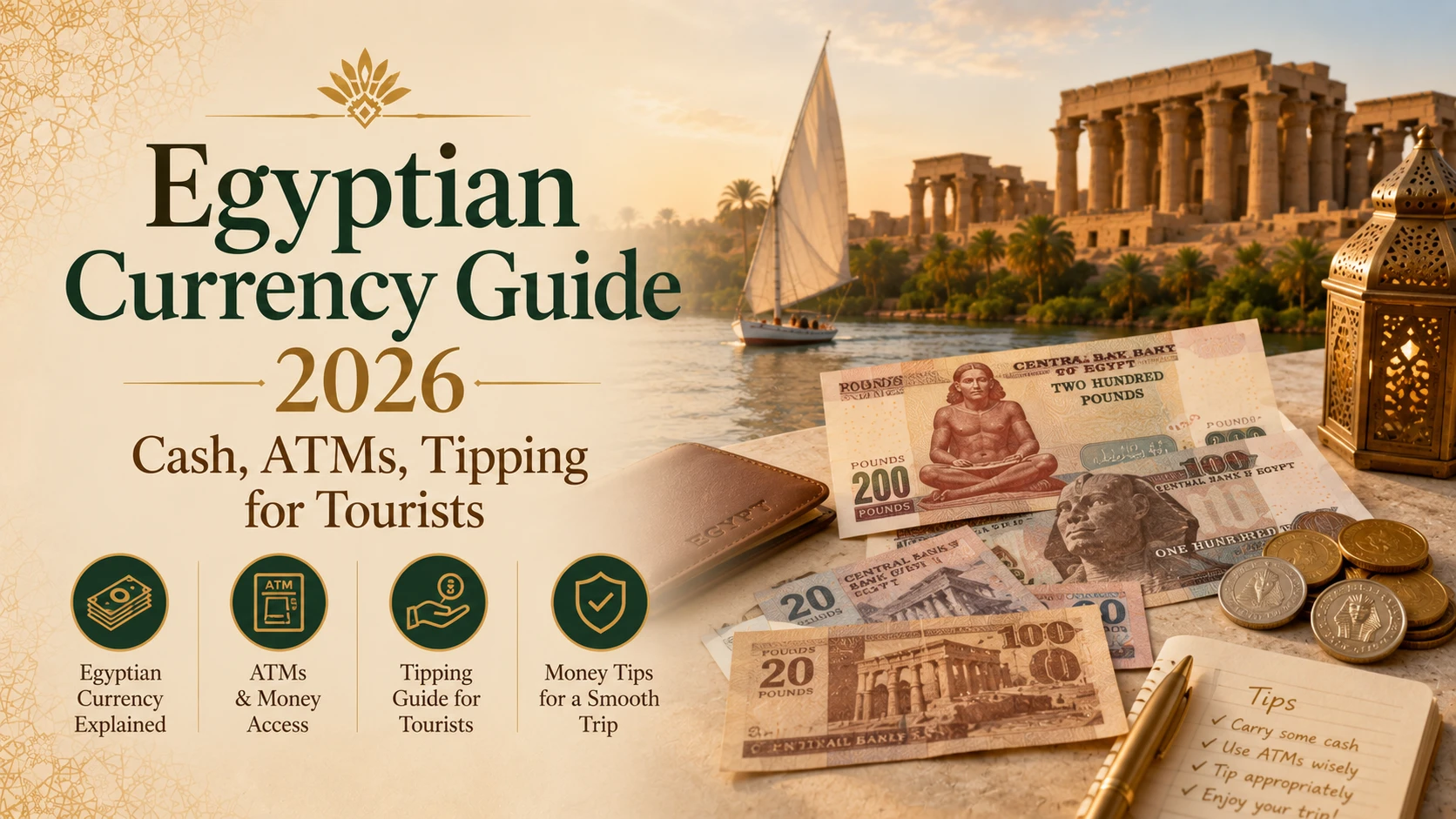
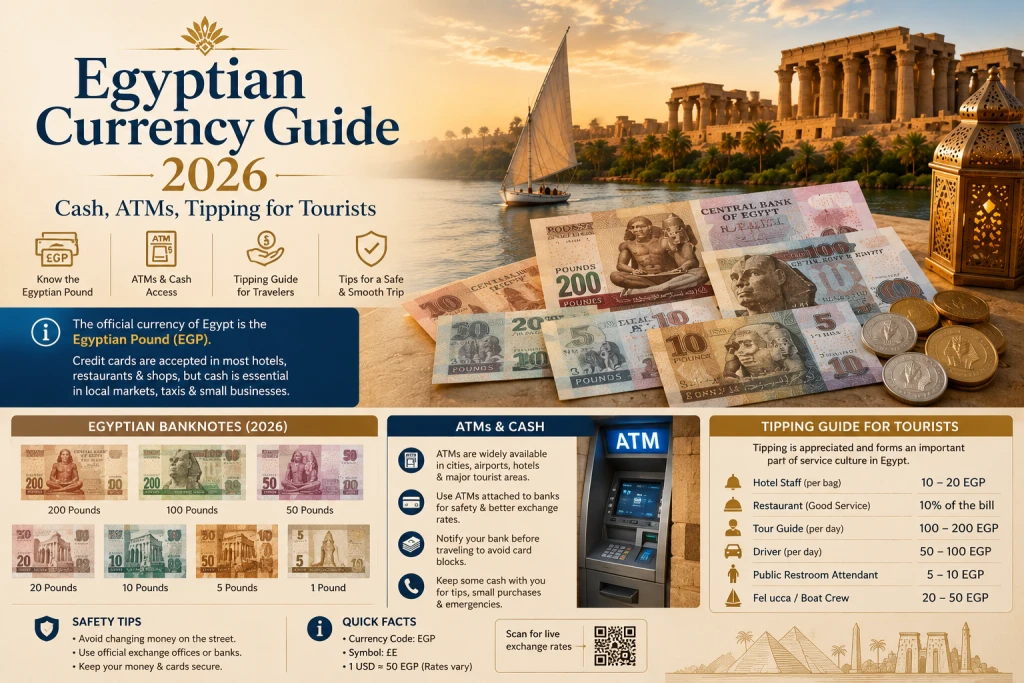
Egypt’s official currency is the Egyptian Pound, abbreviated EGP or written locally as £E or LE. One pound divides into 100 piastres, though piastres are rarely seen in everyday transactions.
Banknotes in current circulation: 5, 10, 20, 50, 100, and 200 EGP. The 200 EGP note is the largest in normal use. New polymer versions are being phased in gradually alongside the older cotton notes. Both are valid. All notes are bilingual – Arabic on one side, English on the other.
Coins exist for 25 piastres, 50 piastres, and 1 EGP, but tourists rarely receive them.
Current Exchange Rates in 2026
As of March 2026, the mid-market rates are approximately:
- 1 USD = 52 EGP
- 1 EUR = 60 EGP
- 1 GBP = 70 EGP
- 1 AUD = 36 EGP
- 1 CAD = 38 EGP
The Egyptian pound has weakened roughly 10% against the dollar over the past 12 months, and analyst forecasts expect it to stay in this range through 2026. Check the day-before rate on Google, XE.com or the Central Bank of Egypt.
How Much Cash to Bring to Egypt
For a typical 10-14 day Egypt trip with pre-booked hotels, tours and a Nile cruise package (all included in your booking), plan on $50-80 USD per person per day in cash for tips, small purchases, drinks off the cruise, and market shopping.
Practical amounts for a two-person, 14-day trip:
- Budget travelers: $600-800 USD
- Mid-range travelers: $800-1,200 USD
- Luxury travelers: $1,200-1,800 USD
Bring US dollars or euros in clean, undamaged bills. Torn, marked, or older-series notes are frequently rejected by exchange offices and even at Cairo airport. Ask your bank for crisp new bills before you fly.
Do not exchange large amounts of cash before you arrive. Rates outside Egypt are usually 5-10% worse than what you get from a Cairo ATM or exchange office.
Using ATMs in Egypt
ATMs are the best way to get Egyptian pounds. You get the interbank exchange rate, which is the fairest available anywhere. The catch is fees.
Typical ATM fees for foreign cards in 2026:
- Egyptian ATM fee: EGP 40-60 per transaction (some banks are free)
- Your home bank foreign withdrawal fee: usually $3-5 per transaction
- Foreign transaction fee (currency conversion): usually 1-3% of the amount
Per-transaction limits are typically 3,000-5,000 EGP (roughly $60-100 USD). Bundle withdrawals to spread the flat fees across larger amounts.
Best banks for tourist ATMs
Withdraw from bank-affiliated ATMs at major banks—National Bank of Egypt (NBE), Banque Misr, CIB (Commercial International Bank), and QNB Alahli. Avoid standalone ATMs in tourist bazaars and unmarked kiosks, which occasionally skim cards.
ATMs are everywhere in Cairo, Alexandria, Luxor, Aswan, Hurghada, and Sharm El Sheikh. On a Nile cruise between Luxor and Aswan, there is no ATM on board, and the small stops (Edfu, Kom Ombo) have limited or no reliable ATMs. Withdraw enough in Cairo or Luxor before you board.
Card skimming and safety
Use ATMs attached to bank branches, ideally during banking hours (9 AM to 3 PM Sunday to Thursday). Cover the keypad when entering your PIN. If an ATM asks whether to charge in your home currency or EGP, always choose EGP—the home-currency option (dynamic currency conversion) adds a hidden 3-5% margin.
Currency Exchange Offices
Exchange offices (called “sarraf” in Arabic) offer a fair rate—usually 2-3% below the interbank rate. Better than airports and hotels, slightly worse than ATMs. Zero fees.
Reliable exchange options:
- Official bank branches: NBE, Banque Misr, CIB, HSBC (very fair rates)
- Downtown Cairo exchange offices along Talaat Harb or Kasr El Nil streets
- The Amex office in Zamalek
- Airport exchange desks at Cairo, Hurghada, or Sharm—convenient, but rates are 3-5% worse than downtown
Bring your passport. Exchange offices are required to photocopy your passport and visa page for any transaction.
Scams to avoid
Never exchange money with street traders offering a better rate. This is the most common scam in Egypt – you receive counterfeit bills, or the count is short by 200-500 EGP, or the rate quoted is not the rate delivered. Only use banks or licensed sarraf offices with visible signage and receipts. Our Egypt safety guide covers this and other common tourist scams in detail.
Credit and Debit Cards in Egypt
Card acceptance in 2026 is better than it was even two years ago, but still uneven.
Where cards work reliably
- 4-star and 5-star hotels (final bill payment)
- Nile cruise ships (bar tabs, spa, laundry)
- Upmarket restaurants in Cairo, Alexandria, Hurghada, and Sharm
- Licensed tour operators for tour and package payments
- Modern supermarkets (Carrefour, Metro, Gourmet)
- Grand Egyptian Museum and other major attractions
Where you need cash
- Taxis, Uber, and Careem (some accept cards; most prefer cash)
- Small restaurants and street food
- Khan el-Khalili and other markets
- Baksheesh (tips)
- Small entrance fees at minor sites
- Bottled water, snacks, small purchases anywhere
Visa and Mastercard are accepted everywhere card payments work. American Express has patchy acceptance – bring it as a backup, not a primary card. Contactless payment is now common in Cairo and the beach resorts.
Baksheesh – The Egyptian Tipping Culture
Tipping in Egypt is not optional or generous – it is the way service workers earn most of their income. The word is baksheesh, and it applies to almost every transactional interaction: porters, guides, boatmen, temple guards who show you an extra tomb, the man at the bathroom, and staff on your Nile cruise.
Standard tipping amounts in 2026
- Hotel porter: EGP 20-30 per bag
- Hotel housekeeping: EGP 30-50 per night
- Restaurant server: 10% of the bill if service is not included
- Taxi driver: round up the fare
- Local guide on a group tour: EGP 100-200 per day per traveler
- Private Egyptologist guide: EGP 300-500 per day per traveler
- Nile cruise crew: $8-12 USD per person per day, pooled and distributed
- Nile cruise captain and cruise director: separate envelope of $20-40 USD
- Temple photograph attendants and “guides” offering to show extras: EGP 20-50
- Bathroom attendant: EGP 5-10
How to handle Baksheesh gracefully
Carry a mix of small notes – 5, 10, 20, and 50 EGP – for the constant small tips. Bigger notes come out for guides, cruise staff, and drivers at the end of the day. Cash is expected. Nobody wants your loose change or foreign coins.
Tip in Egyptian pounds where possible. Small USD or EUR notes are accepted for larger tips (guides, cruise crew) but the recipient loses value when they exchange them. Local currency is more respectful and more useful.
Cash-vs-Card Strategy for Your Egypt Trip
The system that works for most travelers:
- Land at Cairo airport with $500-800 USD in clean bills.
- Exchange $100-150 at the airport for immediate needs (taxi, tips, small meals).
- Withdraw EGP 3,000-5,000 from a reliable ATM in Cairo on day 2.
- Use your credit card for hotel final bills, cruise incidentals, restaurant meals over EGP 500, and major shopping.
- Withdraw again before you board your Nile cruise in Luxor – no ATM on board.
- Keep small EGP notes segregated in a separate wallet purely for tips.
Never carry all your cash and cards together. Split them between your day wallet, your money belt, and the hotel safe. Our Nile cruise packing list includes recommended money belt and wallet options.
| Planning your Egypt trip?
Our all-inclusive packages cover hotels, transfers, guides, cruise, and entrance fees – so you only need cash for tips and personal shopping. Save on the guesswork. |
Frequently Asked Questions Egypt Currency Guide 2026
Categories
- Egypt and Jordan Tours (12)
- Egypt Destinations (44)
- Egypt Nile Cruises (52)
- Egypt Sightseeing (19)
- Egypt Tour Packages (32)
- infographics (1)
-

Nile Cruisers Reviews
30 Apr 2026
-

Hidden Cairo: The Places Most Tourists Never See, Through a Local’s Eyes
14 Oct 2026
-

Why Ending Your Nile Cruise in Marsa Alam Is the Ultimate Way to Unwind
06 Oct 2026
-
4-Day vs 7-Day Nile Cruise: What’s the Difference?
01 Oct 2026
-

Kalabsha, Wadi el-Seboua & Amada: The Rescued Temples Most Tourists Never See
26 Sep 2026
-

“The Museum Xi Jinping Had to See And Why It Belongs on Your Itinerary Too”
18 Sep 2026
-
Is Egypt Expensive to Visit? A Complete Travel Budget
18 Sep 2026
-
Nile Cruisers Reviews
30 Apr 2026
-
Hidden Cairo: The Places Most Tourists Never See, Through a Local’s Eyes
14 Oct 2026
-
Why Ending Your Nile Cruise in Marsa Alam Is the Ultimate Way to Unwind
06 Oct 2026
-
4-Day vs 7-Day Nile Cruise: What’s the Difference?
01 Oct 2026
-
Kalabsha, Wadi el-Seboua & Amada: The Rescued Temples Most Tourists Never See
26 Sep 2026






Comments