By Hesham Elgammal on 18 Jun 2026
Who was Tutankhamun?
Tutankhamun, commonly known as King Tut, was the last and greatest pharaoh of the Royal Egyptian family to rule the Egyptian Kingdom. He ruled during the 18th dynasty in Egypt, and there were no successors to the throne after his death.
King Tut was the greatest of the monarchs, and his coronation happened when he was 8 years old. He was succeeded to the throne under the leadership of his penultimate pharaoh, Ay, who must have been his relative. The Tomb of King Tutankhamun is so widely famous among people because of the mystery and myths it holds within it. It is believed that anyone who tried to enter the tomb, and touch or open the sarcophagus died untimely, including the great excavators and archaeologists George Herbert and Howard Carter.
Tutankhamun was buried under debris for several years until it was rediscovered in 1914 by Theodore Davis from the Valley of the Kings. The rediscovery alone took 9 years, starting in 1905 and ending in 1914.
These facts combined make this tomb an obvious addition to the Egypt tour packages. Also, the name Tutankhamun used in several movies gave this tomb the value it has today among visitors.
Why The Tutankhamun Tomb
The Tutankhamun tomb is widely famous because of several reasons. Let us read some facts that highlight the tomb and why you should not miss this destination when you book your Egypt tour packages.
- It was first excavated in the year 1922 by Howard Carter. During the excavation process, his mentor and patron, George Herbert, died mysteriously, fanning the fuel that the tomb was cursed and whoever tried to enter or tamper with it shall die. All other excavators and archaeologists died sometime after the trial to excavate the tomb and open the casket.
- Secondly, several attempts were made to raid and rob the tomb, but not a single one succeeded. All the attempts to steal the belongings of King Tut from the tomb failed, and the robbers died too.
- Thirdly, it has 4 chambers, an entrance staircase, and a corridor, which are pretty small and less decorated than they were supposed to be. This conclusion is assumed because King Tut died untimely before even constructing his burial place, so he had to be buried in a smaller tomb.
- The low elevation and positioning of the tomb saved King Tut’s sarcophagus from several floods and debris; not a single piece of debris could enter his sarcophagus. His sarcophagus got buried until it was revived and rediscovered years later.
- Lastly, King Tut was recognized as the most prominent and influential pharaoh of Egypt, and some artifacts from his tomb are considered antique, like the golden funerary mask.
Embellishments in the Tutankhamun Tomb
- King Tut’s Tomb is marked with seals inscribed with Egyptian hieroglyphic texts indicating King Tut’s services towards God. It is believed that this helped the deceased on his journey toward heaven.
- The burial place in the Tomb is surrounded by walls painted with several images on a yellow background. The image on the East wall displays Tutankhamun’s funeral procession, and the north wall shows Ay’s coronation of King Tut as the successor to the Egyptian throne.
- The South wall displays King Anubis, Hathor, and Isis, and the West wall depicts 12 baboons that were believed to carry the KIng’s soul to the netherworld.
- All these paintings and scriptures are inspired by the Amarna period, during which King Tut ruled Egypt.
Where to find the tomb?
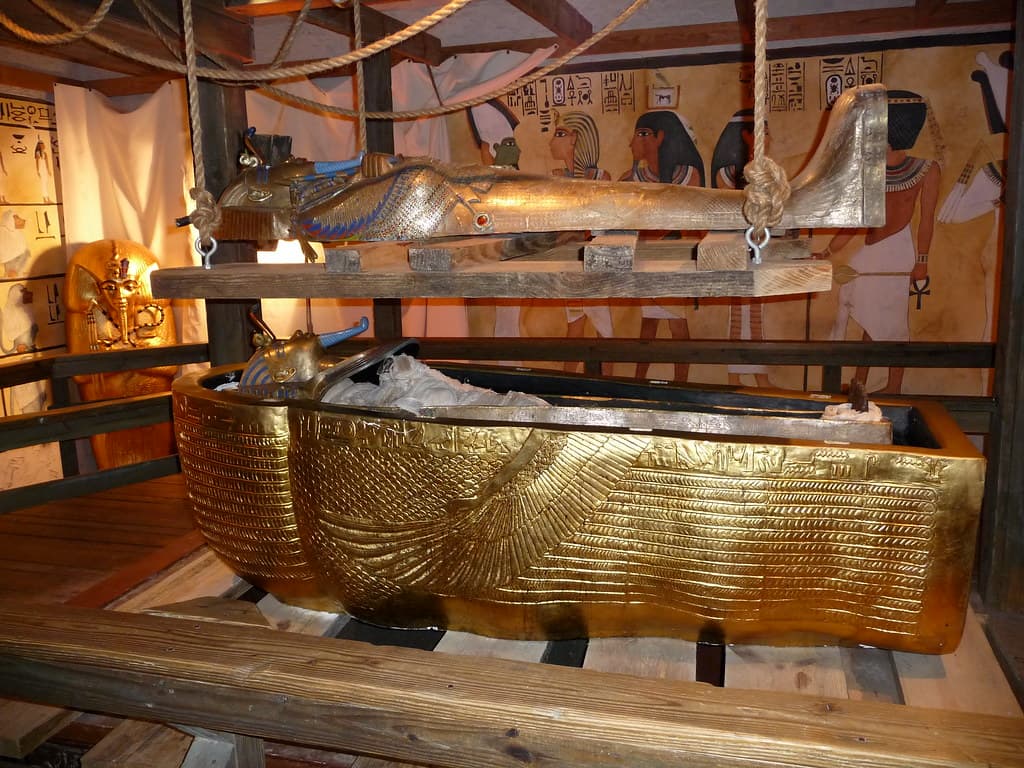
The Tomb of King Tutankhamun, officially known as KV62, is located within the limestone bedrock of Luxor’s Valley of the Kings. The tomb, low on the floor of the valley, had always been vulnerable to flash floods and heavy visitor traffic, both of which threatened the ancient wall paintings. To preserve this fragile marvel for future generations while still offering a world-class experience, a stunning, hyper-realistic replica of the burial chamber was built nearby, close to Carter House, allowing travelers to marvel at the details without disturbing the original structures below ground.
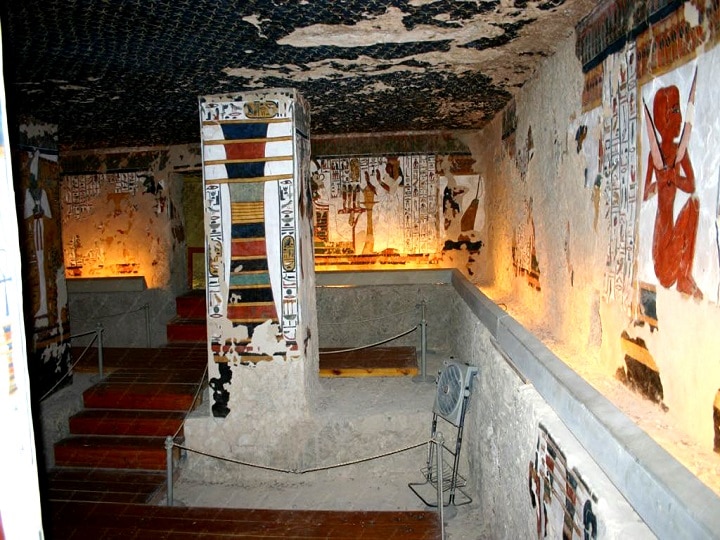
Valley of the Kings – Nile Cruise
Entering the Tomb
The entrance of the tomb starts with 16-step stairs descending just beneath an overhang. The entering corridor is almost 26 feet long and 5 feet wide in breadth, followed by a wide antechamber almost 26 feet long. The treasury placed with the tomb is 16 feet long and is placed below the antechamber along with the annex and the coffin.
The most exciting part is that the antechamber has a tiny hole in its walls, which was utilized as the only source of light to the burial place for maneuvering the casket through the room.
The burial chamber is the most exciting place to see because it is surrounded by ‘magic bricks’ which are inscribed with ancient protective Egyptian spells that were supposed to protect the King’s soul from any disturbance and to protect the people from the King’s soul as well.
Visiting The Tomb
If you have booked an Egypt tour package before your arrival, it will have a guide instructing you on how to reach the tomb. But if you want to explore it on your own without assistance from a guide, you can do that as well. Let us see how to visit the Tom.
- The Egypt tour packages usually do not include the fee to enter the Tomb of Tutankhamun. If you want to see it, you might have to pay a little extra money.
- You start at the Visitors Center and take a ticket to enter the Valley of the Kings. From there, you will ride a 3-minute tram that will take you directly to KV-62.
- However, if you are keen to explore the whole area on foot, you may have to walk uphill to reach the entrances.
- The cost to enter is $14.5 per person, which is quite nominal.
- If you are new to Egypt and want to know the history of the pyramids and pharaohs, then you must include a guide in your Egypt tour package.
The Complete Treasures: Moving to the Grand Egyptian Museum (GEM)
King Tutankhamun’s mummy still rests in his actual tomb (KV62) in the Valley of the Kings, but the vast wealth buried with him has found a magnificent new home. For decades, his treasures were dispersed or displayed in the older Egyptian Museum in Tahrir Square. Today a massive, state-of-the-art gallery space dedicated solely to the Boy King opened its doors at the Grand Egyptian Museum (GEM) near the Giza Pyramids.
For the first time since Howard Carter broke the seal in 1922, visitors can see all 5,000+ items together in one location. This spectacular display includes his world-famous solid gold funerary mask, his ornate golden chariots, royal jewelry, beds, and even the miniature linen clothing he wore as a child.
Check out more about tour packages that include a visit to the Tomb of Tutankhamun
This article was updated and rewritten in part by Hesham El Gammal on Jun 18th, 2026.
Categories
- Egypt and Jordan Tours (12)
- Egypt Destinations (44)
- Egypt Nile Cruises (52)
- Egypt Sightseeing (19)
- Egypt Tour Packages (31)
- infographics (1)
-

Nile Cruisers Reviews
30 Apr 2026
-
Why Ending Your Nile Cruise in Marsa Alam Is the Ultimate Way to Unwind
06 Oct 2026
-
4-Day vs 7-Day Nile Cruise: What’s the Difference?
01 Oct 2026
-
Kalabsha, Wadi el-Seboua & Amada: The Rescued Temples Most Tourists Never See
26 Sep 2026
-

“The Museum Xi Jinping Had to See And Why It Belongs on Your Itinerary Too”
18 Sep 2026
-
Is Egypt Expensive to Visit? A Complete Travel Budget
18 Sep 2026
-
My Morning at the Grand Egyptian Museum: What It’s Really Like to Visit in 2026
12 Sep 2026
-
Nile Cruisers Reviews
30 Apr 2026
-
Why Ending Your Nile Cruise in Marsa Alam Is the Ultimate Way to Unwind
06 Oct 2026
-
4-Day vs 7-Day Nile Cruise: What’s the Difference?
01 Oct 2026
-
Kalabsha, Wadi el-Seboua & Amada: The Rescued Temples Most Tourists Never See
26 Sep 2026
-
“The Museum Xi Jinping Had to See And Why It Belongs on Your Itinerary Too”
18 Sep 2026






Comments