By Manal on 26 Sep 2026
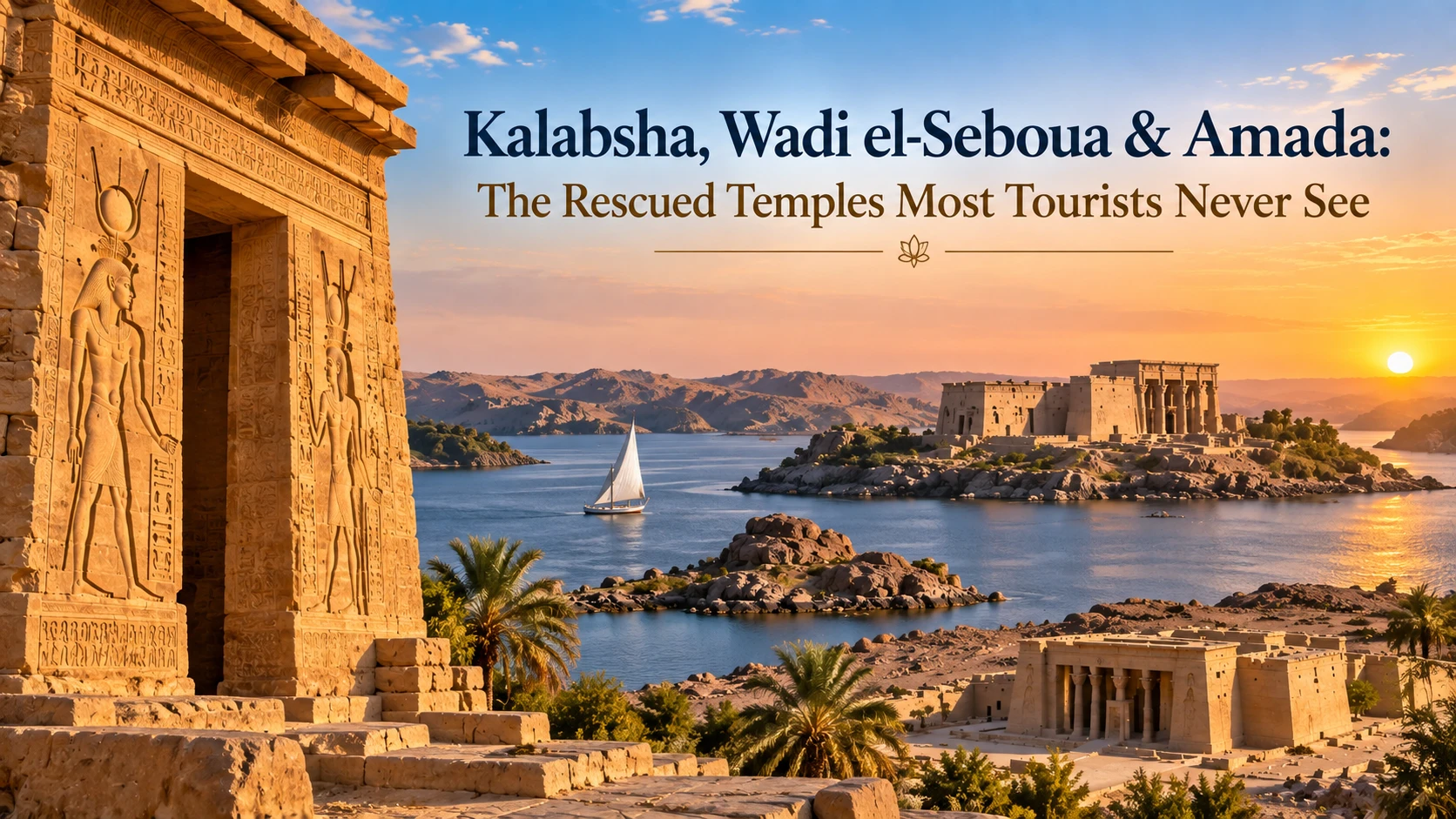
Everyone knows Abu Simbel. The two colossal facades of Ramesses II get all the postcards, all the sunrise photos, all the fame. But here at Nile Cruisers, this is the part of Egypt we love introducing our guests to most: some of the most moving, most peaceful, and frankly most photogenic temples in the whole country are the ones almost nobody talks about—and you can only reach them by water.
This is exactly the stretch of Egypt our Lake Nasser Nile Cruise is built around. Sail south from Aswan across the glassy blue expanse of Lake Nasser with us, and you’ll drift past a string of ancient sanctuaries that were quite literally saved from drowning. Kalabsha, Wadi el-Seboua, and Amada aren’t tucked behind velvet ropes or swarmed by tour buses. They sit in golden desert stillness, mirrored in the lake that almost swallowed them whole. If Abu Simbel is Egypt’s showstopper, these three are its best-kept backstage stories—and after years of sailing this route, we’ve built our itinerary specifically so you don’t miss them.
A Lake Built on a Rescue Mission
Let’s rewind for a second, because the backstory here is honestly wilder than most of the mythology carved into these temple walls.
When Egypt began building the Aswan High Dam in the 1960s, engineers knew the resulting reservoir—what we now call Lake Nasser—would stretch nearly 300 miles south, submerging an entire stretch of ancient Nubia under water. More than twenty historic sites stood directly in the flood path. UNESCO launched an international rescue campaign, and in one of the most ambitious heritage-preservation efforts ever attempted, teams from around the world dismantled these temples stone by numbered stone and rebuilt them on higher ground.
It worked. Beautifully. And today, sailing our route past these relocated monuments feels less like sightseeing and more like witnessing a happy ending in person.
Abu Simbel Cruise
Kalabsha: The Giant Hiding in Plain Sight
Your first stop with us after leaving Aswan is New Kalabsha, a promontory just above the High Dam. It’s easy to overlook on a map, but in person it’s a showstopper—this is actually the largest free-standing temple in all of Egyptian Nubia, and most visitors have never heard its name until our guides introduce them to it.
Built around 30 BCE and dedicated to Mandulis, the Nubian sun god, the Temple of Kalabsha has survived Roman rule, a stint as a Christian church, and a dramatic rescue from the rising waters. Wander through with your Nile Cruisers guide, and you’ll also find the smaller, no-less-charming Temple of Beit el-Wali nearby, with painted reliefs of Ramesses II in battle that still hold their color after thousands of years. Time it right, and we’ll have you up toward the sanctuary at sunset for uninterrupted views across the lake—quiet, golden, and almost entirely yours.
Wadi el-Seboua: The Valley of the Lions
A little further south, the landscape opens into pure Sahara—sand in every direction, with a temple complex rising out of it like a mirage. This is Wadi el-Seboua, which translates to “Valley of the Lions,” named for the sphinx-lined avenue that leads up to its main temple, and it’s a highlight we build a dedicated stop around on every sailing.
Here you’ll actually find three rescued monuments standing together: the temple of Wadi el-Seboua itself, the Temple of Dakka, and the Temple of Maharraqa, all connected by a short desert walking track. It’s one of the few places on the whole cruise where you really feel the isolation—no crowds, no noise, just carved stone and sky. If you’re the kind of traveler who loves a photo where you’re the only human in frame, this is the stop our guests talk about most.
Amada: Nubia’s Oldest Surviving Temple
Save some energy for Amada, because this is the history nerd’s favorite stop on the whole itinerary—and our onboard Egyptologists genuinely light up here. Amada is the oldest standing temple in Nubia, its earliest chambers commissioned by Pharaoh Thutmose III around 1450 BCE and later expanded by his son Amenhotep II and grandson Thutmose IV—three generations of pharaohs, one sanctuary.
What makes Amada genuinely special isn’t just its age; it’s the color. The painted reliefs inside are some of the best-preserved in Egypt, thanks to an unlikely stroke of luck: early Christians plastered over many of the original carvings to convert the space into a church, and in doing so, accidentally protected the pigments underneath for centuries. When the temple was moved to safety in the 1960s, restorers uncovered artwork that looks almost freshly painted. Nearby, keep an eye out for the rock-cut Temple of Derr, another relocated Ramesses II monument our guides can easily combine with an Amada visit.

Why This Is the Experience We Recommend
A Nile cruise between Luxor and Aswan will always be the classic Egypt experience, and rightly so. But a Lake Nasser cruise is its wilder, quieter cousin — fewer boats, fewer crowds, and a landscape that feels genuinely untouched. You get Abu Simbel’s grandeur bookending a journey filled with intimate, half-forgotten temples that most travelers fly straight past on their way south, and it’s the route we, as Egypt-based specialists, recommend most to guests who’ve already done the classic Nile itinerary and want something deeper.
Our advice, from years of running this exact route: give yourself the full multi-night sailing rather than a rushed day trip. The magic of Lake Nasser is in the slowness — watching the desert change color at golden hour, waking up moored beside a temple with no one else around, and letting the whole trip unfold at the pace of the water rather than a checklist. That’s precisely how we design every departure.
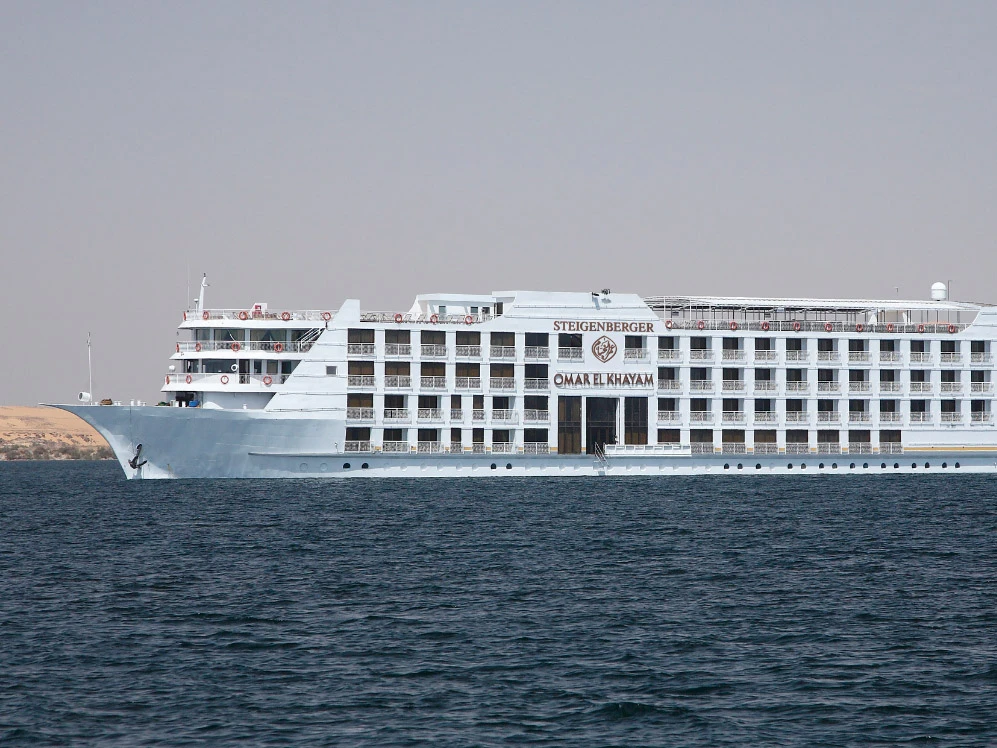
Our Lake Nasser cruise packages are built exactly around this rhythm, weaving Kalabsha, Wadi el-Seboua, and Amada into a seamless sail toward Abu Simbel, with our own Egyptologist guides on board to bring every relief and inscription to life. Most of our guests book this experience aboard the Steigenberger Omar El Khayam, a five-star ship known for its sun deck pool, spacious balcony cabins, and genuinely excellent onboard food — a comfortable, elegant base from which to explore some of Egypt’s most underrated ancient sites, and one of the vessels we know and trust best on this route.
Ready to book the experience yourself? Head to our Nile Cruise & Lake Nasser Cruise Package page to see full itineraries, ship options, and available departure dates. Our team plans this route every week, so if you’re weighing itinerary lengths or cabin categories, just reach out—we’ll help you match the sailing to exactly what you’re after.
A few practical tips before you book:
- Best time to go: October through April offers the most comfortable desert temperatures for shore excursions.
- Pack for both worlds: light, breathable clothing for the day and a layer for cooler evenings on deck.
- Bring a real camera if you can: Phone cameras struggle with the contrast of white stone against a blazing desert sky — a polarizing filter helps enormously.
- Go easy on the itinerary: These sites reward slow wandering more than rapid-fire photo stops.
Abu Simbel will always steal the spotlight, and it deserves to. But Kalabsha, Wadi el-Seboua, and Amada are the temples that make you feel like you’ve actually discovered something—because, in a very real sense, an entire generation of engineers and archaeologists made sure you still could. And with Nile Cruisers, discovering them is as easy as booking the sail.
Lake Nasser Cruise FAQs
Categories
- Egypt and Jordan Tours (12)
- Egypt Destinations (44)
- Egypt Nile Cruises (52)
- Egypt Sightseeing (19)
- Egypt Tour Packages (32)
- infographics (1)
-

Nile Cruisers Reviews
30 Apr 2026
-
Hidden Cairo: The Places Most Tourists Never See, Through a Local’s Eyes
14 Oct 2026
-
Why Ending Your Nile Cruise in Marsa Alam Is the Ultimate Way to Unwind
06 Oct 2026
-
4-Day vs 7-Day Nile Cruise: What’s the Difference?
01 Oct 2026
-
Kalabsha, Wadi el-Seboua & Amada: The Rescued Temples Most Tourists Never See
26 Sep 2026
-

“The Museum Xi Jinping Had to See And Why It Belongs on Your Itinerary Too”
18 Sep 2026
-
Is Egypt Expensive to Visit? A Complete Travel Budget
18 Sep 2026
-
Nile Cruisers Reviews
30 Apr 2026
-
Hidden Cairo: The Places Most Tourists Never See, Through a Local’s Eyes
14 Oct 2026
-
Why Ending Your Nile Cruise in Marsa Alam Is the Ultimate Way to Unwind
06 Oct 2026
-
4-Day vs 7-Day Nile Cruise: What’s the Difference?
01 Oct 2026
-
Kalabsha, Wadi el-Seboua & Amada: The Rescued Temples Most Tourists Never See
26 Sep 2026






Comments