By admin on 21 Mar 2026
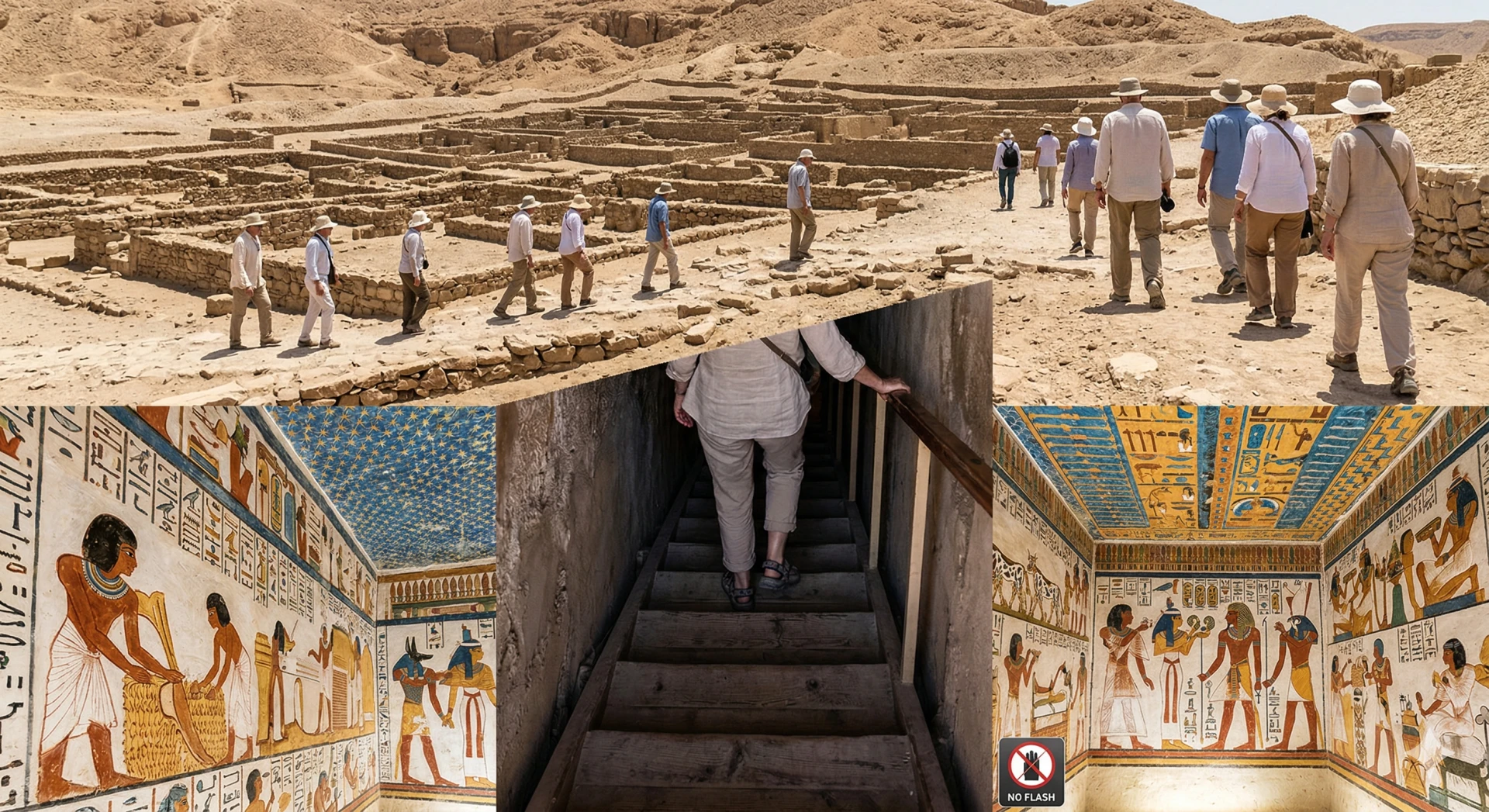
While most Nile cruise itineraries highlight the grand royal burials, a visit to the sightseeing of Deir el-Medina, the Valley of the Artisans, offers a much more intimate and human perspective on ancient Egypt. This was the village of the master craftsmen—the painters, scribes, and stonemasons—who built the magnificent tombs of the pharaohs. Because these men were the era’s elite artists, the private tombs they built for themselves, such as the Tomb of Sennedjem, are among the most vibrant and exquisitely preserved in Luxor. Unlike the sprawling royal galleries, these chambers are smaller but burst with “high-definition” colors and scenes of daily life, farming, and family that feel surprisingly modern.

Historical Significance of the Valley of the Artisans
Deir el-Medina is a small village on the west bank of the Nile, not far from the ancient city of Thebes. This place is very important in history since it was where the people who made the tombs in the Valley of the Kings and the Valley of the Queens lived. These expert artisans, who are typically left out of the big stories of ancient Egypt, were very important in building some of the most famous monuments in history.
Pharaoh Thutmose I built Deir el-Medina during the 18th dynasty, circa 1550 BCE. The town was a place for artisans to live and work, giving them a unique place to do both in relative isolation. For generations, the artists and their families lived here, forming a close-knit community that was committed to their work.
The artisans were able to focus on their work because the village was close to the royal necropolises. The tombs they built were not just places to bury people; they were also exquisite works of art meant to help the pharaohs get to the afterlife safely. Deir el-Medina is historically important not only because it helped Egyptian art and architecture, but also because it showed how regular people lived in ancient Egypt.
The Life of Artisans in Ancient Egypt
The artists of Deir el-Medina had hard but fulfilling lives. These men were quite good at what they did, and many of them learned their trade from their fathers. They were in charge of carefully planning, carving, and adorning the graves, which needed a lot of knowledge about religious symbols and a lot of attention to detail.
There was a rigorous hierarchy among the artisans, with a foreman in charge of their work. Some of them worked on carving the tomb walls, some on painting, and some on writing the hieroglyphic inscriptions. Even though the structure was strict, the artisans worked together, and each person’s job was important to the project’s success.
The artists of Deir el-Medina had to work hard, but they also had a lot of benefits. The state gave them regular amounts of food, clothes, and other things they needed. Also, because the tombs they created were so close to them, their work was generally seen as a religious responsibility, which gave them a high status in society. This mix of hard labor, ability, and respect was what made their way of life so special.
The Role of Deir el-Medina in Tomb Construction
Deir el-Medina was a particularly important place for erecting tombs during the New Kingdom period of ancient Egypt. The hamlet was established especially for the skilled workers who built the tombs for the pharaohs and other significant persons in society. This small village for artists let them focus on their craft without having to worry about how to get by every day.
The craftsmen who built the tombs in Deir el-Medina were split into groups, and each group was in charge of a different phase of the building process. The procedure began with rigorous planning, during which the tomb’s layout and decorative motifs were decided. After that, the artisans started to build the tomb by cutting it out of rock and painting and carving elaborate designs on the walls.
People who worked at Deir el-Medina built more than just tombs. They also built chapels and shrines throughout the necropolis. Because they were so good at their jobs, the artisans were able to make some of the most exquisite specimens of ancient Egyptian art and architecture. This ensured that the pharaohs’ graves would survive forever and be a good memory of their time in power.
Daily Life and Work Conditions of the Tomb Builders
The daily life of the artisans in Deir el-Medina was marked by a strict routine and a strong sense of community. The workday began early in the morning, with the artisans gathering their tools and heading to the tombs. They worked in challenging conditions, often in confined and poorly lit spaces, relying on oil lamps to illuminate their intricate tasks.
Work conditions were demanding, with the artisans often spending long hours in the tombs, carving and painting. Despite the physical challenges, the artisans were highly motivated by the importance of their work. They believed that their efforts were essential for ensuring the pharaohs’ safe journey to the afterlife, a belief that gave their work a profound spiritual significance.
The artisans’ lives were not solely defined by their work. Deir el-Medina was a vibrant community with a rich social life. The artisans lived with their families in modest but well-constructed houses, and the village had its own amenities, including a communal well, a temple, and a necropolis for the residents. Festivals, religious ceremonies, and communal gatherings were an integral part of life in Deir el-Medina, fostering a strong sense of camaraderie among the artisans and their families.
Artistic Techniques and Tools Used by the Artisans
The folks who built Deir el-Medina did a great job. They built the beautiful tombs that have astounded people for hundreds of years, using many different forms of art and tools. They had to know a lot about both art and the religious symbols that were important to ancient Egyptian culture in order to do their jobs well.
One of the most important things the craftsmen did was relief carving. This is when they sculpted pictures of people and scenes onto the rock walls of the tombs. There were many steps in this process. First, the forms were drawn in a rough fashion. Then, details were added slowly. To get the effect they wanted, the painters utilized a lot of different instruments, such as chisels, hammers, and stone polishers.
The craftsmen were also good at painting, in addition to carving. They made stunning hues by using natural pigments from plants and rocks to paint the tomb walls. To make sure the paint stuck to the surface, these pigments were blended with a binding agent like egg white or gum arabic. The artists utilized magnificent brushes made of reeds or animal hair to paint realistic pictures of different parts of the hereafter.
Archaeological Discoveries and Findings
The archaeological discoveries at Deir el-Medina have provided invaluable insights into the lives of the artisans and the construction of the tombs. Excavations at the site have uncovered a wealth of artifacts, including tools, pottery, and personal items, as well as the remains of the artisans’ houses and communal buildings. These findings have shed light on the daily life, work practices, and social structure of the village.
One of the most significant discoveries at Deir el-Medina is the extensive collection of written records, including letters, legal documents, and literary texts. These documents were written on ostraca (pottery shards) and papyrus, and they provide a detailed account of the artisans’ lives, their work, and their interactions with each other and the outside world. The records reveal the challenges the artisans faced, including disputes over wages, conflicts with officials, and issues related to their work and living conditions.
The tombs themselves are among the most remarkable discoveries at Deir el-Medina. The artisans’ own tombs, located in the village’s necropolis, are beautifully decorated with scenes from their daily lives and religious beliefs. These tombs provide a unique perspective on the artisans’ own views of the afterlife and their place in society. The combination of written records and physical artifacts has made Deir el-Medina one of the most well-documented sites in ancient Egypt, offering a rare glimpse into the lives of the people who built the tombs.
Essential Tourism Advice from the Experts at Nile Cruisers™
- Be Prepared for the Heat: Even in the winter months, the West Bank sun is intense. We strongly advise wearing breathable, light-colored clothing and a wide-brimmed hat.
- Prioritize Footwear: The terrain at the artisan village is uneven, rocky, and sandy. Closed-toe walking shoes are necessary to traverse the village ruins and the steep, narrow descents into the burial chambers.
- The Early Bird Advantage: Most Nile cruise groups head to the Valley of the Kings first. To enjoy Deir el-Medina in near-solitude, plan your visit for the early morning (6:00 a.m.–8:00 a.m.).
- Hydration is Key: While we provide bottled water on our guided transfers, always carry an extra bottle. Note that tap water in Egypt is not safe for drinking; use it only for showering or brushing your teeth.
- Photography Rules: Policies on interior photography can change. Always check with your Egyptologist guide before using your camera inside the tombs to avoid fines or equipment confiscation.
- Respect Local Customs: While the ship has a relaxed dress code, the West Bank is a traditional area. We appreciate modest attire that covers shoulders and knees, as it demonstrates respect for the local community.
Preserving the Place: Our Sustainable Code of Conduct
As a visitor to Deir el-Medina, you are stepping into a delicate ecosystem of 3,500-year-old history. To ensure these masterpieces remain vibrant for generations to come, Nile Cruisers™ asks our guests to follow these simple Sustainable Code of Conduct guidelines:
- Look, Don’t Touch: The oils and moisture from human skin can cause irreversible damage to the ancient pigments. Please keep a safe distance from all painted surfaces and stone carvings.
- The “No Flash” Rule: Intense light causes colors to fade over time. If you are taking photos, ensure your flash is strictly turned off. In many tombs, photography is restricted entirely—please respect these signs and your guide’s instructions.
- Keep it Quiet and Calm: The burial chambers are small and enclosed. To minimize the impact of CO₂ and humidity on the artwork, we keep group sizes small and limit the time spent inside each tomb.
- Stay on the Paths: To protect the structural integrity of the workmen’s village ruins, please remain on the designated wooden walkways and gravel paths.
- Waste-Free Exploration: Help us keep the West Bank pristine. Please carry all litter back to the ship for proper disposal, and use refillable water bottles to reduce plastic waste.
Categories
- Egypt and Jordan Tours (12)
- Egypt Destinations (44)
- Egypt Nile Cruises (50)
- Egypt Sightseeing (19)
- Egypt Tour Packages (30)
- infographics (1)
-

Nile Cruisers Reviews
30 Apr 2026
-

Misleading Claims & False Information – Nile Cruisers™ Official Notice
08 Feb 2026
-

“The Museum Xi Jinping Had to See And Why It Belongs on Your Itinerary Too”
18 Sep 2026
-
Is Egypt Expensive to Visit? A Complete Travel Budget
18 Sep 2026
-
My Morning at the Grand Egyptian Museum: What It’s Really Like to Visit in 2026
12 Sep 2026
-

Why a Luxury Nile Cruise Should Be at the Top of Your Bucket List
11 Sep 2026
-

My First Look at Mövenpick SB Hayah Dahabiya: Launch Day with Our Longtime Nile Cruise Partners
02 Sep 2026
-
What’s Really Included in an All-Inclusive Nile Cruise?
28 Aug 2026
-
Nile Cruisers Reviews
30 Apr 2026
-
Misleading Claims & False Information – Nile Cruisers™ Official Notice
08 Feb 2026
-
“The Museum Xi Jinping Had to See And Why It Belongs on Your Itinerary Too”
18 Sep 2026
-
Is Egypt Expensive to Visit? A Complete Travel Budget
18 Sep 2026
-
My Morning at the Grand Egyptian Museum: What It’s Really Like to Visit in 2026
12 Sep 2026
-
Why a Luxury Nile Cruise Should Be at the Top of Your Bucket List
11 Sep 2026






Comments